








We fine-tune large language models including GPT, LLaMA, and Mistral on your proprietary data, adapting them to your tone, domain vocabulary, and specific tasks such as customer support automation, document summarisation, internal knowledge retrieval, and content generation.

Avg. Accuracy Improvement


We fine-tune pre-trained vision models such as ResNet, YOLO, and Vision Transformers on your specific image or video datasets, improving performance on tasks like defect detection, medical imaging analysis, retail shelf recognition, and custom object classification at production scale.
Detection Accuracy

We fine-tune NLP models including BERT, RoBERTa, and T5 on industry-specific corpora covering sectors such as legal, healthcare, finance, and e-commerce, enabling highly accurate text classification, named entity recognition, sentiment analysis, and question answering within your domain.
Domain NLP Precision

We apply Reinforcement Learning from Human Feedback (RLHF) and instruction tuning techniques to align AI model behaviour with your preferred outputs, tone, and safety requirements, ensuring your fine-tuned models respond accurately, consistently, and in line with your brand and compliance standards.
Output Consistency Gain



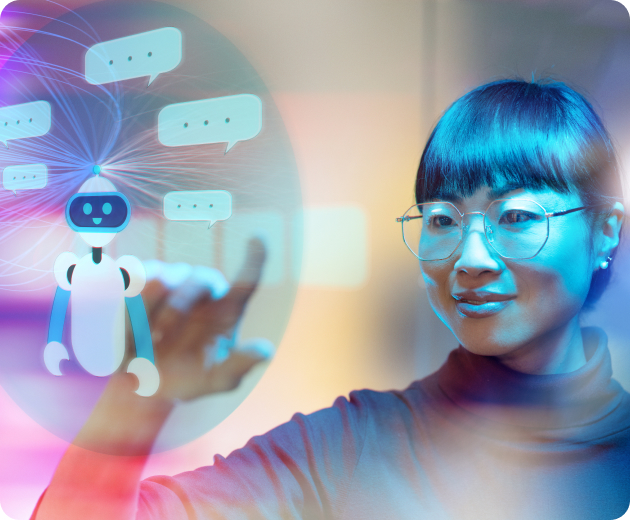
AI Model Fine-Tuning allows businesses to take the power of world-class foundation models and adapt them precisely to their own data, language, and industry context. Whether you need a legal document classifier that understands your contract structure, a vision model trained on your manufacturing line, or a language model that speaks in your brand voice, fine-tuning delivers the accuracy and specificity that generic models simply cannot match.
We review your existing data, identify the most suitable foundation model for your use case, and define the fine-tuning objectives, evaluation criteria, and success metrics aligned to your business goals.
We prepare and annotate your training data, configure the fine-tuning pipeline, and train the model using techniques such as LoRA, RLHF, or supervised fine-tuning, validating performance at every stage against your target benchmarks.
We evaluate the fine-tuned model against held-out test sets, apply further refinements to address edge cases, and deploy the final model with ongoing monitoring to ensure it maintains accuracy as your data and requirements evolve.
Fine-tuning adapts a pre-trained foundation model to your specific data, domain, and task requirements. Rather than building a model from scratch, fine-tuning leverages the knowledge already embedded in large models and refines it to perform with high accuracy on your particular business use case, saving significant time and cost.
Data requirements vary depending on the model type and task complexity. For many NLP fine-tuning tasks, a few hundred to a few thousand labelled examples can yield strong results. For vision models, more data is typically required. We assess your available data during the discovery phase and advise on whether augmentation or additional annotation is needed.
We work with a wide range of foundation models including GPT, LLaMA, Mistral, BERT, RoBERTa, T5, CLIP, ResNet, and YOLO variants. We select the most appropriate base model based on your use case, data type, performance requirements, and deployment constraints.
Yes. Data security is a core part of our process. We work within your preferred infrastructure, whether cloud-based or on-premise, and apply strict access controls, data handling protocols, and confidentiality agreements to ensure your proprietary data is protected throughout the fine-tuning engagement.
Timelines depend on the complexity of the task, the volume of training data, and the model being fine-tuned. Lightweight NLP fine-tuning projects can be completed in one to two weeks, while more complex vision or multimodal fine-tuning engagements may take four to eight weeks including data preparation, training, and evaluation cycles.
Yes. We regularly work with models that were developed in-house or acquired from third-party providers. Our team conducts a thorough model audit, identifies performance gaps, and applies targeted fine-tuning or instruction tuning techniques to improve accuracy, consistency, and alignment with your current business requirements.

Book a free 15-minute consultation to explore how AI can transform your business processes.
